
Your Child Changed Overnight. That Is Not Normal — and It Is Not in Your Head.
May 7, 2026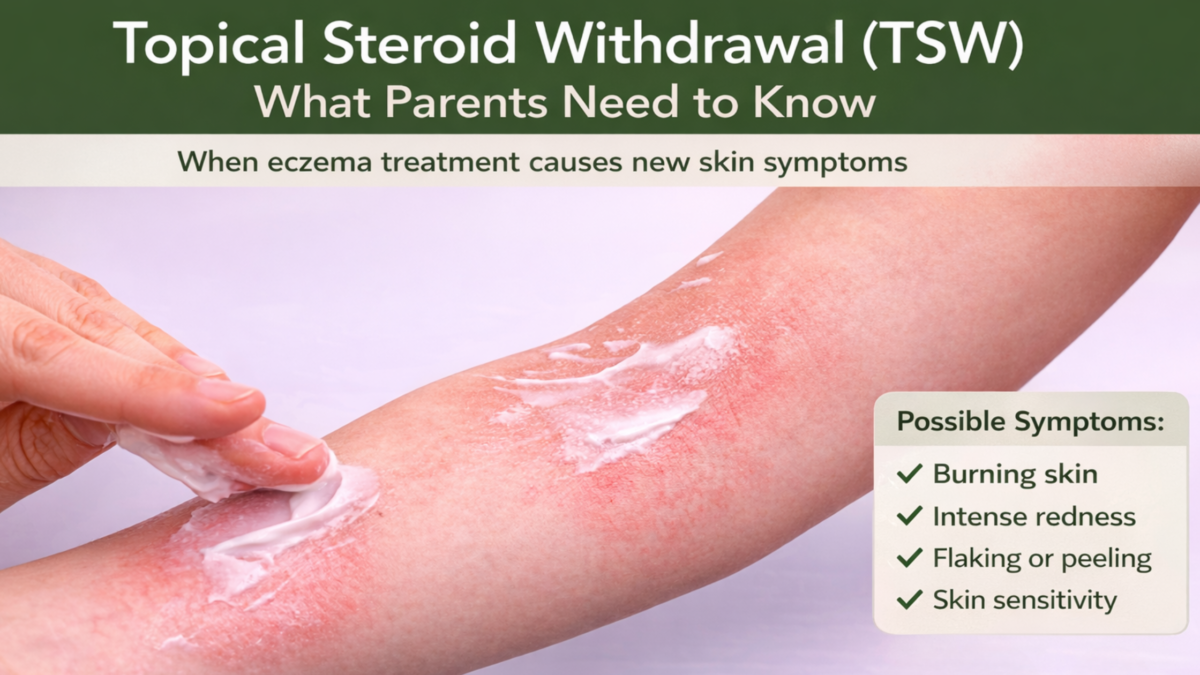

Medically Reviewed by Kimberly Steinberg, APRN, CPNP-PC
Topical steroid withdrawal (TSW) can occur after long-term steroid cream use for eczema. Learn the symptoms, causes, and what parents should know about TSW in children.
Parenting kids with eczema can feel like riding a roller coaster blindfolded. One minute, there’s relief; the next, all-out flame wars with your child’s skin.
If your child had an eczema flare after stopping steroid cream, you may have seen the term Topical Steroid Withdrawal (TSW) lighting up TikTok and parenting groups.
And honestly?
You’re not alone in wondering:
Is it real?
Is this what’s happening to my child?
Or is this just severe eczema?
Let’s unpack what science knows, what’s still debated, and most importantly, how we help families heal smarter, not just harder.
At Greater Atlanta Integrative Pediatrics, we often see families who feel stuck between worsening symptoms and limited answers.
Why This Topic Is Everywhere Right Now
With endless reels, memes, and personal stories, it’s easy to panic and assume steroids are the enemy.
But fear is a lousy doctor.
At GAIP, we take concerns seriously while grounding our guidance in real pediatric science and years of experience in functional medicine.
The NIH and dermatology literature recognize Topical Steroid Withdrawal, but also note that it remains incompletely understood and sometimes overdiagnosed.
That nuance matters. The goal is not to dismiss parents.
The goal is to properly identify what’s happening.
What Are Topical Steroids?
Topical corticosteroids are anti-inflammatory medications prescribed to calm dermatitis, including eczema and allergic rashes.
They work by:
• Suppressing inflammatory cytokines
Calming the chemical “alarm signals” that make skin red and swollen.
• Constricting blood vessels (vasoconstriction)
Temporarily tightening tiny skin vessels to reduce redness and warmth.
• Calming overactive immune signaling
Helping the immune system stop overreacting in the skin.
Used correctly — right potency, limited duration, medical supervision — they are generally safe and effective.
That last part is critical.
So… What Is Topical Steroid Withdrawal?
Also called Red Skin Syndrome, TSW describes a condition where skin worsens after prolonged steroid use is stopped.
Parents often report:
- Burning more than itching
- Diffuse redness beyond the original rash
- Oozing or swelling
- Cycles of flare and calm
If your child’s eczema worsened after stopping steroid cream, TSW may be considered — but it is not automatically the diagnosis.
Proposed Mechanisms Behind TSW (What Science Suggests)
Research describes several possible physiologic explanations:
Rebound Inflammation
When inflammation temporarily becomes worse after stopping a medication that was suppressing it, like a spring snapping back.
Rebound Vasodilation
Blood vessels dilate excessively after being chronically constricted, causing intense redness and heat.
Nitric Oxide Dysregulation
Altered vascular signaling may contribute to flushing and burning sensations.
Nerve Hypersensitivity
Tiny skin nerves become overly reactive, leading to burning or stinging rather than classic itch.
Barrier Instability
The outer skin layer becomes weakened, allowing moisture loss and the entry of irritants. Important: These are proposed mechanisms. There is no single diagnostic test for TSW.
Clinical Signs Described in NIH Literature
Certain patterns may suggest steroid-related skin changes:
Red Face Syndrome
Uniform red inflammation with papules and pustules around the mouth and eyes. Prolonged inflammation may lead to visible blood vessels (telangiectasia).
Red Sleeve Sign
A sharply defined rash on arms or legs that stops abruptly at anatomical borders. Palms and soles are usually spared.
Headlight Sign
Clear skin around the nose and mouth surrounded by facial redness.
Elephant Wrinkles
Thickened, less elastic skin at the knees or elbows that may take months to normalize.
These findings support consideration of TSW, but they are not diagnostic alone.
The Most Important Clarification
Not every eczema flare after stopping steroid cream equals TSW.
Other common causes include:
- Severe uncontrolled eczema
- Secondary bacterial infection (especially staph)
- Eczema herpeticum (HSV infection)
- Contact dermatitis
- Environmental triggers
- Food triggers
- Skin barrier breakdown
That distinction changes everything about treatment.
Who’s at Higher Risk?
Kids with these patterns may appear more likely to struggle with withdrawal-like flares:
- Long-term daily steroid use
- High-potency creams
- Use on thin-skinned areas (face, groin)
- Strength escalated over time
- Little medical supervision
But let’s be clear: short, supervised courses are very different from years of unsupervised use.
The Gut-Skin Connection: What Most Parents Aren’t Told
Here’s what often gets overlooked:
Chronic eczema and inflammatory skin conditions are influenced by gut immune signaling and microbiome balance.
Emerging research supports:
- Dysbiosis (imbalance of gut bacteria) contributing to systemic inflammation
- Intestinal permeability (“leaky gut”) increasing immune activation
- Staph colonization (excessive staph overgrowth on the skin) correlates with microbiome imbalance (gut bacteria imbalance)
At GAIP, we evaluate:
- Digestive symptoms
- Antibiotic history
- Food sensitivities
- Immune regulation
- Nutrient status (zinc, vitamin D, essential fatty acids)
- Inflammation stutus
- Neurodevelopment
Sometimes the rash is just the messenger.
Emerging research also highlights the connection between the gut microbiome and skin inflammation in children.
TSW vs. Severe Eczema Flare
What’s the Difference?
Feature | Topical Steroid Withdrawal (TSW) | Severe Eczema Flare |
| Trigger | Often, after prolonged steroid use is stopped | Triggered by allergens, infection, stress, and weather |
| Sensation | Burning > itching | Intense itching |
| Redness Pattern | Diffuse, may extend beyond the original rash | Typically follows eczema distribution |
| “Red Sleeve” Pattern | Possible | Rare |
| Facial Flushing | Common in TSW | Less common |
| Infection Risk | Possible but secondary | Very common |
| Response to Restarting Steroid | May temporarily improve, but relapse | Often improves significantly |
| Timeline | Weeks to months | Days to weeks with treatment |
At Greater Atlanta Integrative Pediatrics in Roswell, GA, we help families throughout North Atlanta navigate complex skin conditions with evidence-based and functional pediatric care
What Should Parents Do If Concerned?
First up: don’t abruptly stop long-term steroids without guidance. That can make any skin situation look worse.
Instead:
✔ Schedule evaluation
✔ Review full medical and treatment history
✔ Evaluate potency, duration, and area of use
✔ Check for infection
✔ Support barrier repair
✔ Address root triggers
✔ Discuss gradual tapering if appropriate
Schedule a Pediatric Consultation
At GAIP, we take a root-cause, whole-child approach. That means not just quelling symptoms, but asking what’s underneath.
How Long Does Recovery Take?
If TSW is suspected:
• Healing may take weeks to several months
• Improvement is gradual
• Progress is not always linear
Every child’s biology is different.
When to Seek Immediate Care
🚨 Fever
🚨 Severe pain
🚨 Rapid swelling
🚨 Eye involvement
🚨 Lethargy
🚨 Rapidly spreading rash
These require urgent medical evaluation.
Final Takeaway: Clarity Over Panic
Topical steroids can be an important and appropriate tool when used properly and intentionally. But fear-based medicine isn’t helpful, and neither is dismissing parental concern. If your child experiences an eczema flare after stopping steroid cream, the answer is not automatic panic, and it’s not automatic denial either. It’s a careful evaluation. You deserve thoughtful, evidence-based, and tailored answers to your child’s unique biology.
At Greater Atlanta Integrative Pediatrics, we don’t practice reactionary medicine.
We don’t minimize your concerns.
And we don’t treat rashes in isolation.
We treat the child, not just the skin. Our integrative pediatric approach looks beyond symptoms to understand why a child’s skin may be reacting this way.
That means we combine:
- Evidence-based pediatrics
- Functional medicine evaluation
- Root-cause investigation
- Individualized care plans
- Longer visits and direct provider access
Topical steroids may be part of the plan.
But they are never the only tool in the toolbox.
Key Takeaways
- Topical Steroid Withdrawal (TSW) is a real but not yet officially recognized condition that may occur after stopping long-term topical steroid use — most commonly in adults, but reported in children too.
- TSW is not the same as an eczema flare. The skin may burn, weep, or cycle in ways that look different from typical eczema — and symptoms often begin at the site of previous steroid use.
- Topical steroids are medically appropriate and important when used correctly. Panic-based discontinuation without a plan can cause more harm than good.
- Risk factors include prolonged use, high-potency steroids, and application to sensitive areas like the face or skin folds.
- Gut health and immune function play a meaningful role in skin inflammation — an integrative evaluation looks at the whole picture, not just the skin surface.
- Recovery from TSW is possible but can be slow and nonlinear. Guidance from a clinician who understands both conventional and integrative care is important.
How an Integrative Pediatric Approach Can Help
If your child is experiencing an eczema flare after stopping steroid cream or if you’re simply unsure what’s happening, you don’t have to navigate it alone.
At Greater Atlanta Integrative Pediatrics, we take the time to look carefully, ask deeper questions, and create a plan that makes sense for your child.
We evaluate the skin.
We evaluate the immune system
We evaluate gut health and triggers.
And we help you move forward with clarity and answers.
If your child is struggling with persistent eczema or concerns about topical steroid withdrawal, our team here at Greater Atlanta Integrative Pediatrics in Roswell, Georgia (North Atlanta Metro), can help guide the next steps.
www.gaipinc.com | 404-751-3693 #1